The actual amount of reduction provided by a Focal Reducer can vary depending upon your specific setup (telescope, placement of focal reducer, sensor depth, etc.). To determine the actual amount of reduction for my equipment, I capture an image with no reducer and another image with the reducer in place, and compare the change in field of view to determine the actual amount of reduction (and thus effective f/value).
Here are my latest results with a Celestron 8" f/10 SCT, my Mallincam DS2.3+ video astronomy camera using MFR-8 and Celestron f/6.3 reducers.
In the past I would capture images, invert the colors to get black stars on a white background and print them. I would then pick two stars that appear in each of the images and use a digital caliper to measure the distance between them on the paper. Dividing the distance between the two stars when using a reducer by the larger distance measured on the image between the same two stars with no reducer gave me the amount of reduction.
Based on suggestions from others, I have started using nova.astronomy.net/upload to simplify this process and improve the accuracy of my process (Google "Nova Astronomy.net upload" to get the link). By clicking on the Browse button you can select one of your captured images and click the Upload button to process it. It will upload and process the file, and after a couple of minutes display "Success" once it has finished processing. You can click on "Go to results page" to view the results. On the right side of the screen under "Calibration", it will show the Size (width x height) in arcmin of your camera's image FOV (and a Radius in degrees). The width & height Size values vary proportionally with the amount of reduction used. I typically use the first FOV Size number (width) for my calculations.
Since the reduced image has a wider Field of View (FOV), to get the amount of reduction you divide the FOV with no reduction by the FOV of the reduced image: FOV Width of Image with no Reduction / FOV Width of Reduced Image = Amount of Reduction. I then compute the effective f value by multiplying the original f/10 value of my telescope by the amount of reduction. Let's say the computed amount of reduction is 0.8, then for my f/10 telescope my setup becomes f/10 x 0.8 = f/8.
I used M103 as my target since it has a good recognizable star field and it is easy to visually see the reduction. Below are the results of various focal reduction combinations with the camera in line with the telescope (no Diagonal in place).
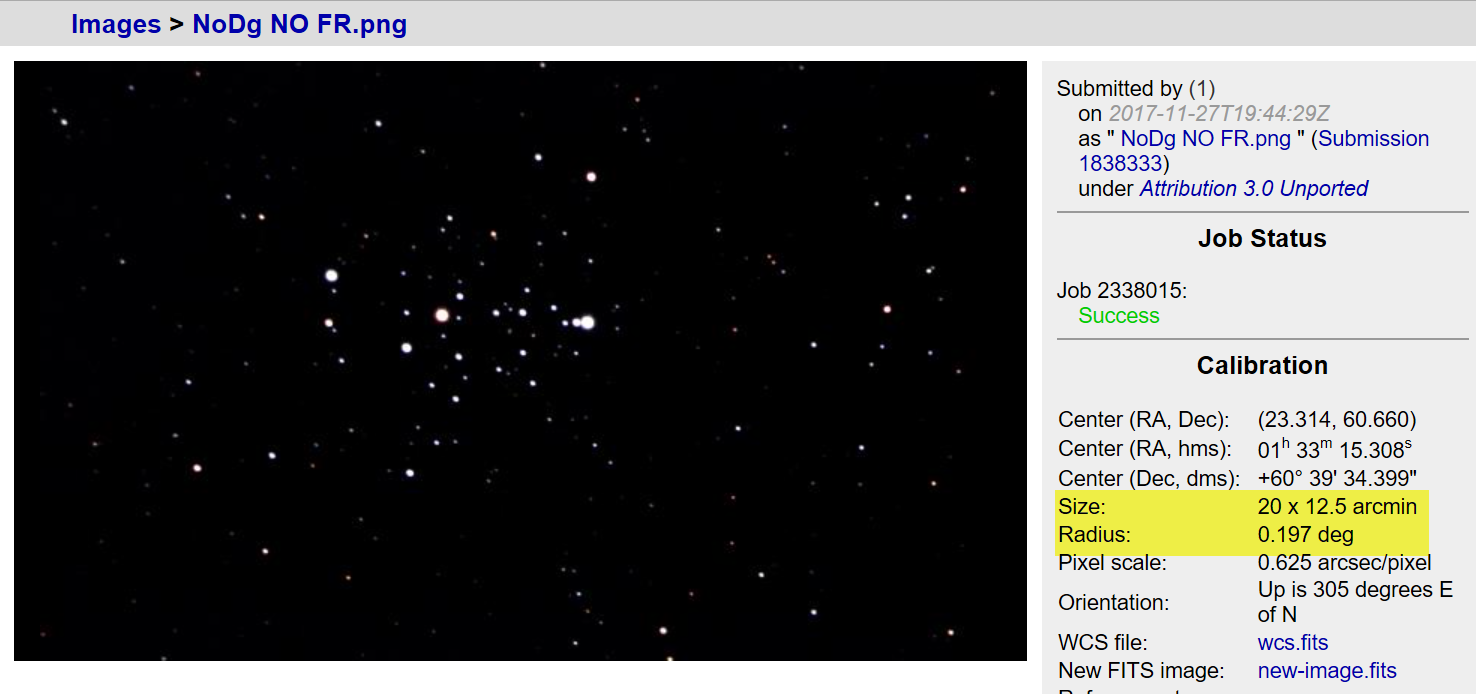
1. C8 SCT with DS2.3+ (camera attached directly to back of telescope with no focal reduction)
FOV Size: 20 x 12.5 arcmin (#1 Width = 20)
f/10 (no reduction)
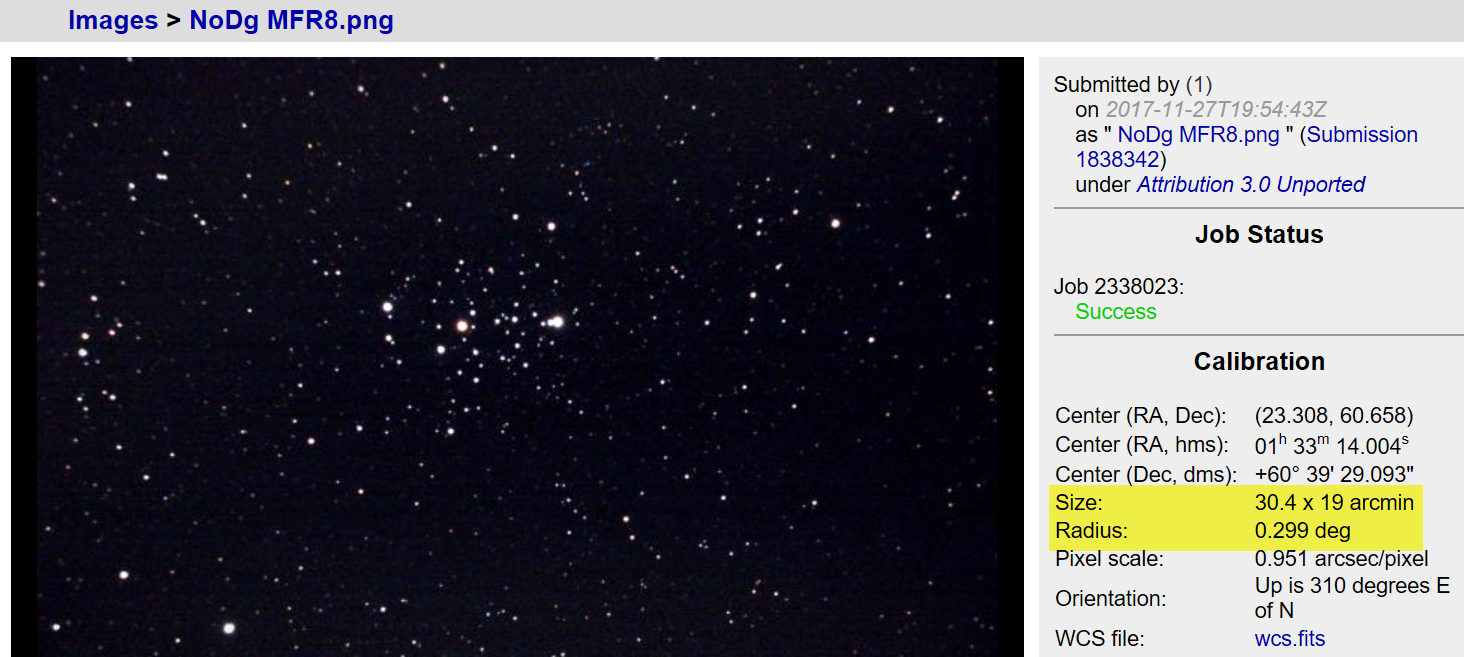
2. C8 SCT with DS2.3+ and MFR-8 (reducer attached to the DS2.3+ with no spacers)
FOV Size: 30.4 x 19 arcmin
Reduction = 20/30.4 = 0.66 (#1 Width/#2 Width)
f/10 x 0.66 = f/6.6
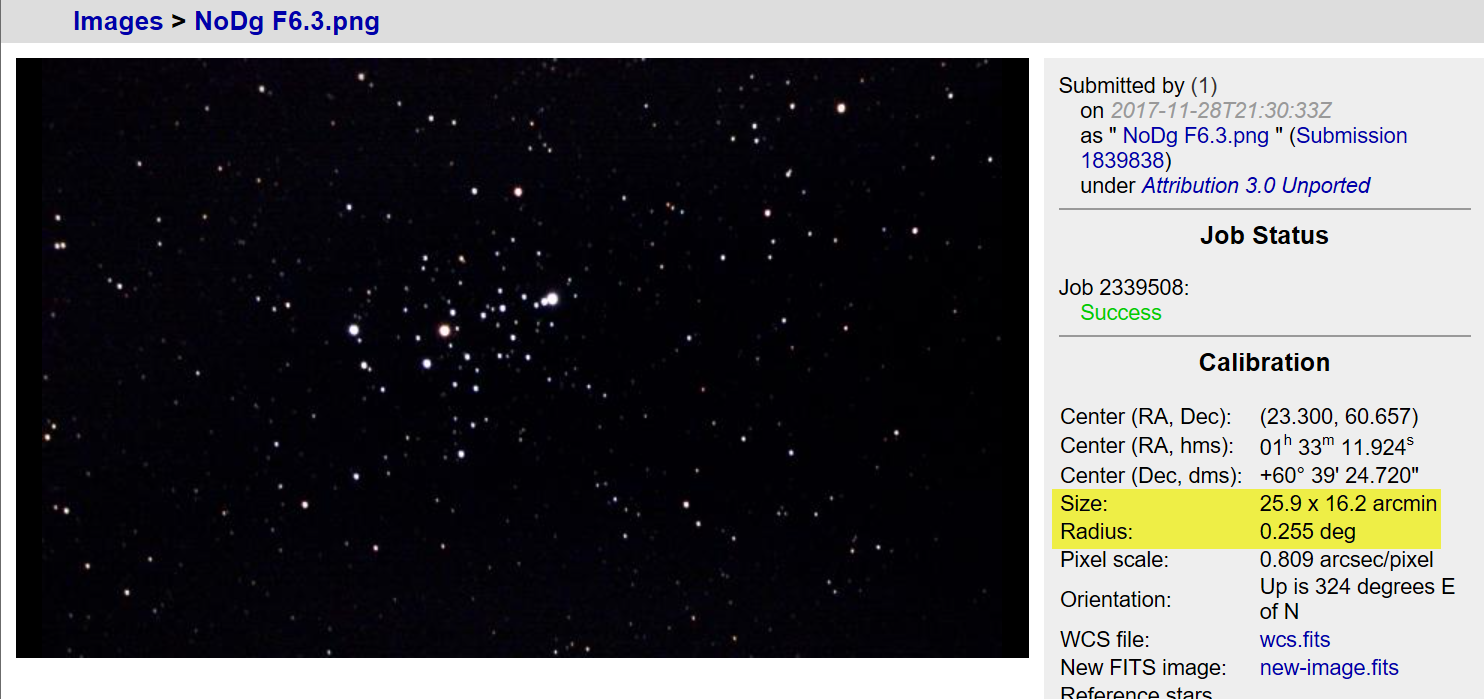
3. C8 SCT with DS2.3+ and Celestron f/6.3 Reducer (reducer attached to the back of the telescope)
FOV Size: 25.9 x 16.2 arcmin
Reduction = 20/25.9 = 0.77 (#1 Width/#3 Width)
f/10 x 0.77 = f/7.7
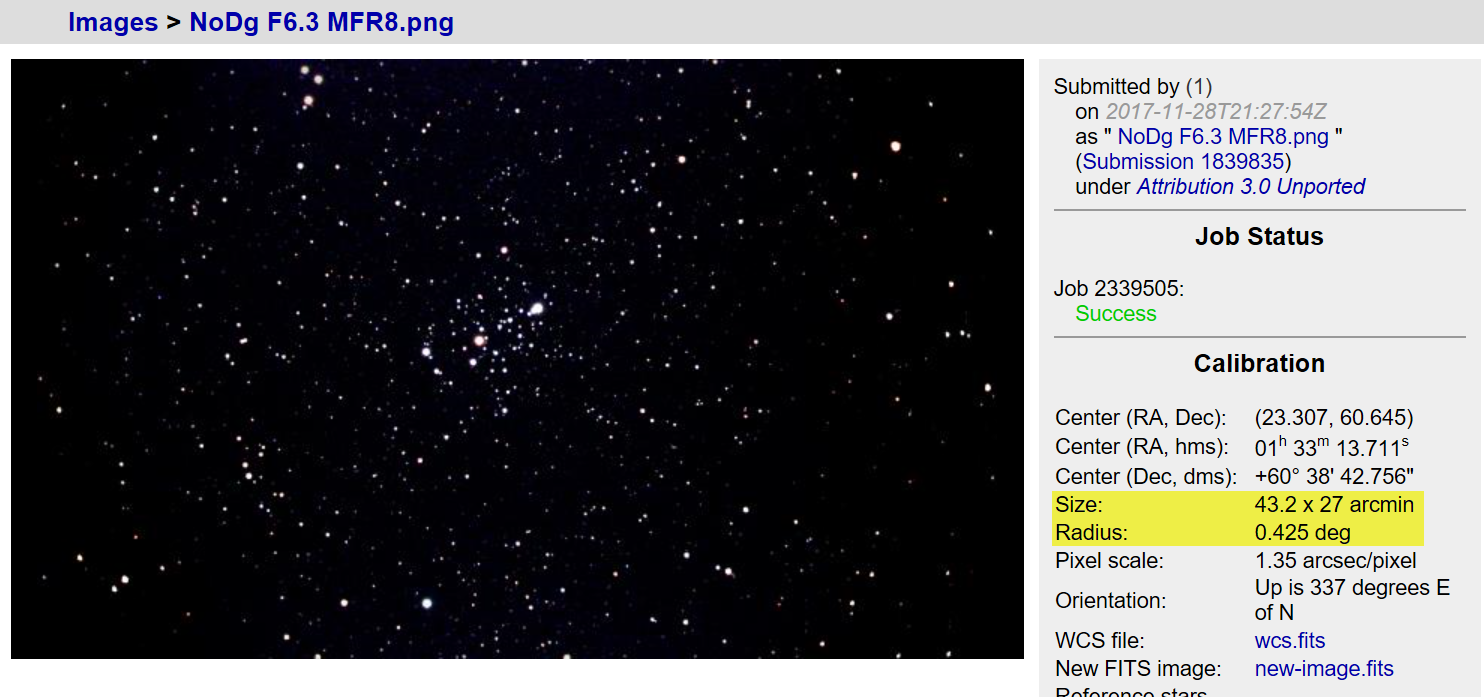
4. C8 SCT with DS2.3+ and MFR-8 (attached to camera) plus Celestron f/6.3 (on the back of the telescope)
FOV Size: 43.2 x 27 arcmin
Reduction = 20/43.2 = 0.46 (#1 Width/#4 Width)
f/10 x 0.46 = f/4.6
I have found that this method for accurately computing the amount of focal reduction works well. Computing the precise f/ratio is another matter.
The computed f values vary from what you might have expected. The actual reduction can vary depending upon the setup (e.g. the distance between the focal reducer and the sensor). In #3, the Celestron f/6.3 Reducer produced f/7.7. If I repeat the same tests with a Diagonal between the telescope and the camera, the f values will be different.
Finding the exact f/ratio may not be that critical, and in general an estimate is good enough. It is a indication of how fast your setup is since the lower the f/ratio, the brighter the image and thus less exposure time is needed (If you halve your f/ratio with a reducer you will go from a f/10 system to f/5, and your images can update in 1/4 the time). Through my testing I did find that using a Diagonal changes my f/10 system to about f/11.6 (the FOV width went from 20 arcmin to 17.2 arcmin when inserting a Diagonal into the light path between the telescope and the DS2.3+ camera).
5. C8 SCT with a Diagonal and DS2.3+ (and no focal reducer)
FOV Size: 17.2 x 10.8 arcmin
Change = 20/17.2 = 1.16 (#1 Width/#5 Width)
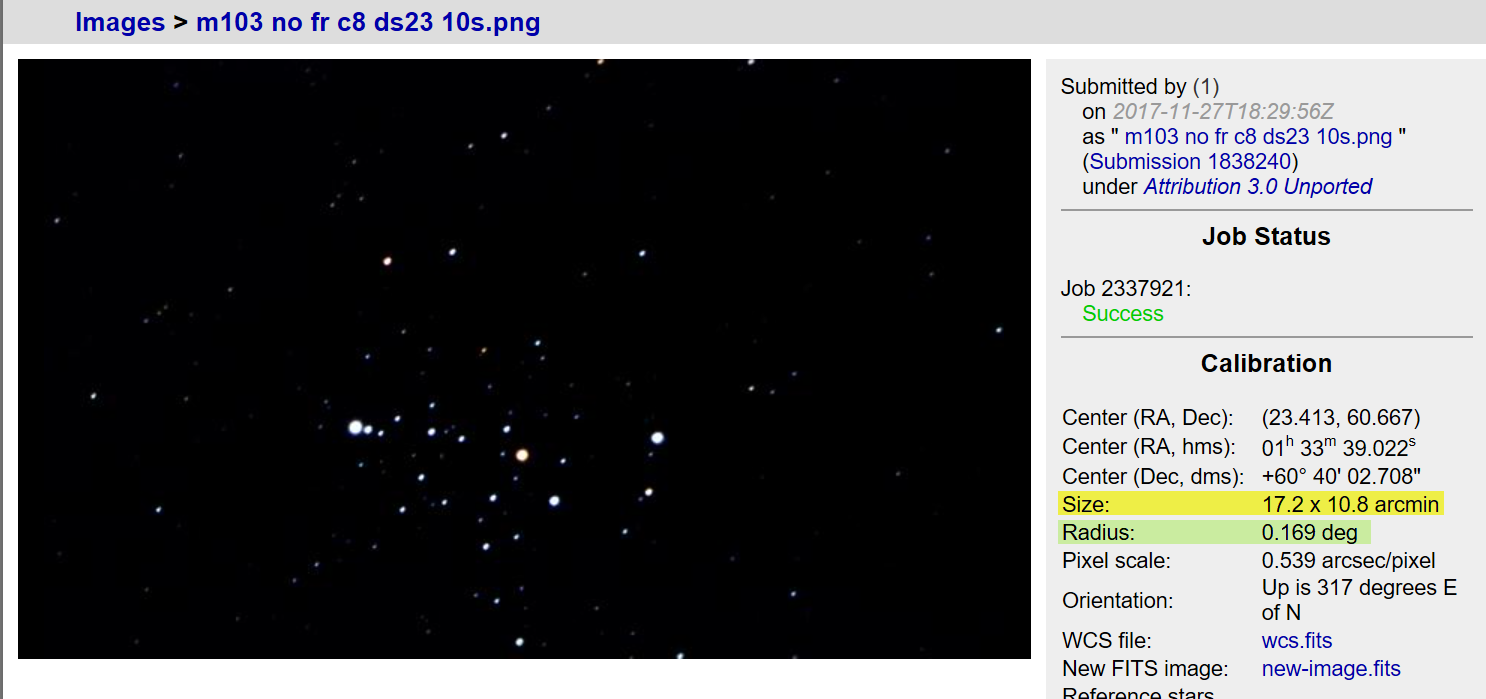
So, if I want to get the max amount of reduction for the brightest image, I learned it is better to use the Camera in line with the telescope (as close to the telescope as possible) rather than on a Diagonal if you can. The image is slightly larger when a diagonal is used. It is not a major difference though, and you may need to use a diagonal if you have an Alt-Az mount and you are trying to avoid hitting the mount.
Generally speaking, if you move the Camera further away from the telescope the image will get bigger, the FOV smaller and the image not quite as bright. When you compare using the DS2.3+ with the MFR-8 without any spacers to using it with spacers, you will see more reduction, larger FOV, and a brighter image. This confused me a little at first since I was thinking the Camera was moving further back in the light path when adding spacers. Then I realized that adding spacers just moves the reducer forward in the light path closer to the telescope - the Camera distance from the telescope does not change. The primary reason there is more reduction is the increased distance between the reducer and the sensor produces a greater amount of reduction.
When I began these tests, it was really more from an interest in quantifying the amount of reduction and the effect on the Field of View in order to have accurate FOV rectangles in SkySafari. Having an engineering background, I'm a numbers kind of guy. It bugs me if I put in parameters in SkySafari and the FOV rectangles don't match what I actually see through the telescope. Now that I know precisely what the reduction ratio is for different setups, I can better use the SkySafari FOV rectangles for various combinations of telescopes, reducers and cameras.
I did find that using both the MFR-8 and the Celestron f/6.3 reducers together begin showing some vignetting effects (darkening around the edges of the image). To get even more reduction without vignetting, I have ordered a HyperStar reducer for my C8 to convert it from f/10 to about f/2.1 (more on this later).
 RSS Feed